
Description
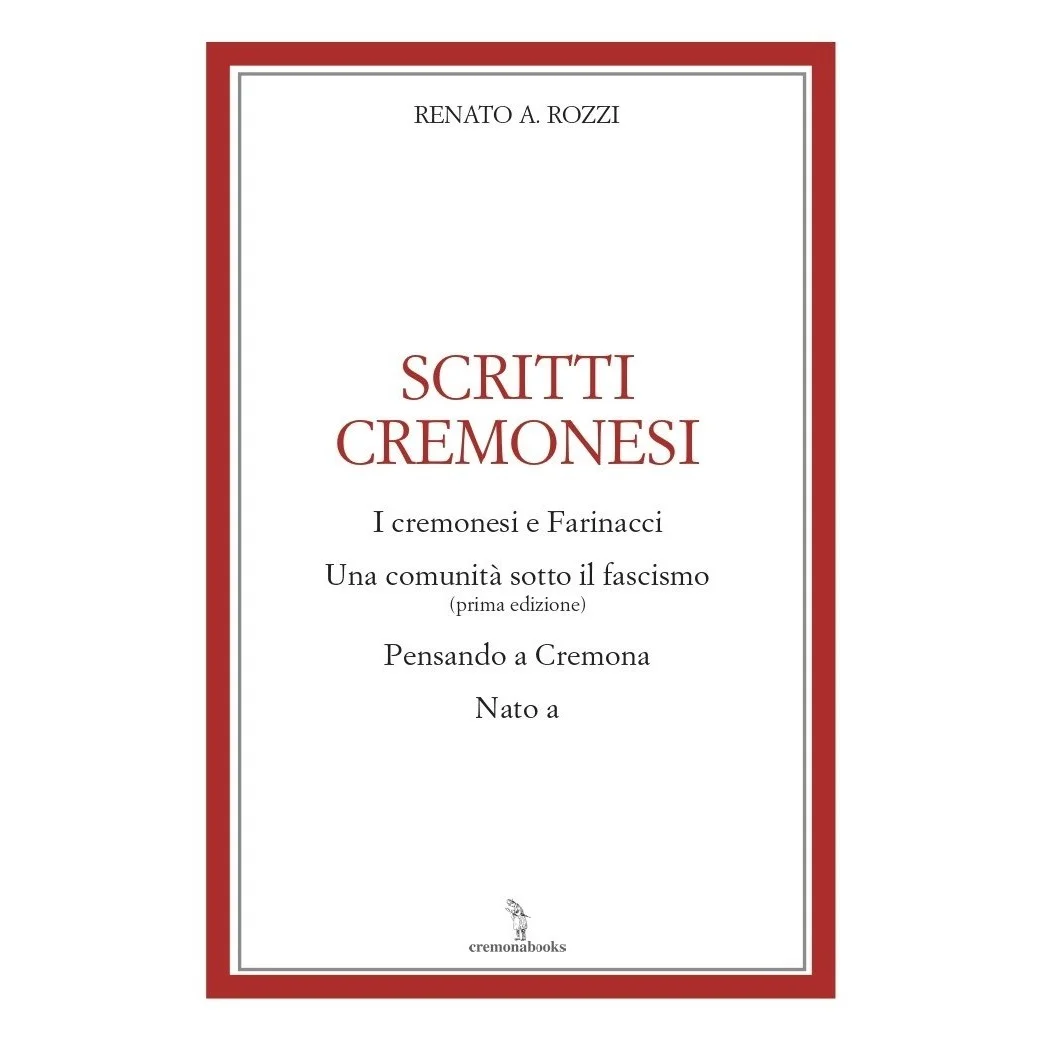
The reprint of Renato Rozzi’s writings: a journey through Cremonese history
This collection grew out of the wish to share Renato Rozzi’s social and human reflections, marked by sharp critical observation and attention to changes in society.
The result of a personal wish to share years of observations on society and people, Renato Rozzi’s sincere interest in human stories shows in every conversation, fuelled by deep questions and cultural references, often handled with lightness and irony. The pages collected here bear witness to free and constant work, born of an ability to grasp social change as it happens. Some of the problems Rozzi pointed out have been solved; others remain. The author’s real lesson is the value of critical, aware and constructive reflection as the basis of freedom and democracy.
Weaving together personal memory and collective reconstruction, the account in I Cremonesi e Farinacci is also an invitation not to forget that history, especially local history, is made of light and shadow, of shared responsibilities and of mistakes that often reappear in new forms. Only through a gaze that is both critical and involved can we truly understand the deeper meaning of the events our community has lived through, and give dignity back to all the voices – including the less heard ones – that have been part of it. Memory thus becomes a living tool of awareness and dialogue, able to guide future choices. The writings collected in the volume show the importance of the author’s personal, empathetic and critical approach to observing society and people, highlighting how his intellectual legacy lies not only in the content but above all in a constructive, free and aware method of analysis, considered essential for democratic and collective growth.
In Pensando a Cremona the author reflects on the profound changes in the Cremonese community between 1950 and 1970, questioning their causes and consequences. He analyses the gradual disappearance of rural life, the exodus of the rural population, the paradox of falling employment and rising prosperity, and the conflicting relationship between town and country. He stresses how modernisation brought wealth but also a loss of identity and collective memory, highlighting the community’s difficulty in recognising and dealing with its historical and social knots. He also criticises the role of the farmers and the lack of real cultural and political innovation on the part of both the middle classes and the left. The study invites an informed judgement on historical processes, highlighting the need not to forget the past and to face change with greater collective responsibility.
The third piece, Nato a, published by Cremonabooks in 2003, completes the journey with further food for thought on themes such as identity, memory and belonging, which are central to Renato Rozzi’s work.
At the suggestion of Professor Luigi Ferrari, author of the foreword, an unpublished text has been added to the new edition: the paper presented at a seminar held at the University of Urbino on 14 April 1994, entitled Una comunità sotto il fascismo (A community under fascism), which makes it possible to explore further the social and political dynamics that have shaped the history of Cremona, enriching the volume with an original and direct perspective.
This extensive text offers a historical and social reconstruction of the Cremonese community, with particular attention to the processes of transformation from the fascist period to the years of the economic boom. The author takes a strongly personal approach, weaving together individual memory and collective reflection and once again focusing on the need for critical awareness of the changes that have marked local society. The text aims to show how historical events are never simply the result of abstract political and social dynamics, but are deeply bound up with the experiences, feelings and relationships of the people who lived through them.
This essay also shows remarkable depth of analysis: the narrative does not merely describe the facts but interprets them in the light of the community’s unresolved knots, such as the peasant question, the dialectic between town and country, the role of the middle classes and of the left, and the weight of memory and local identity. The author dwells on the difficulty of the Cremonese community in recognising and dealing with its own contradictions, denouncing a rather widespread tendency to forget and suppress the most painful moments of its history, above all the rural exodus and the loss of a peasant culture experienced as exclusion and dependence. What emerges is a severe criticism of localism and conservatism, and of the failure to work through historical traumas collectively, reflected in a reluctance to take responsibility and in the prevalence of a sedative culture that is little inclined to dialogue.
Stylistically, the text alternates moments of theoretical reflection with autobiographical memories, in dense, articulate prose which, though sometimes fragmentary, effectively conveys the complexity of the events and social dynamics. The author gives historical examples and cultural references, making use of dialect and local expressions to lend authenticity to the account. The choice to address young people and to offer a critical reading of memory is particularly significant: the work is a tool of civic education, an invitation not to settle for official or self-congratulatory narratives but to question the deep roots of social change and collective responsibility.
In short, this text is an example of social analysis that goes beyond mere chronicle, offering a questioning and aware reading of local history. Its main criticism concerns the community’s inability to face change with openness and courage, often preferring passive acceptance and suppression. The author invites us to recover the sense of conflict as an opportunity for growth and to value all voices, even marginal ones, in order to build a memory that is truly shared and looks to the future still to be built. The final message is entirely about responsibility: only through critical reflection and active, aware participation can we hope for the development of an authentic democracy and a fairer, more caring community.